
Hand and finger fractures, done properly from the start
Fractures of the metacarpals and phalanges, finger joint dislocations and Bennett fracture can look simple, but poor treatment leaves stiffness and deformity that are hard to put right. A short guide to each type and how it is treated.
- Consultant orthopedic and hand surgeon
- Hand surgery fellowship – Leeds, UK
- Kuwait Board in Orthopedic Surgery
 Book your appointment atAs-Salam Hospital – Capital

When does a hand injury need a hand surgeon?
These signs call for an examination and an X-ray, even if you think it is only a sprain.
- Pain and swelling after a blow, a fall or an accident
- A visible deformity of the hand or finger, or a joint that sticks out
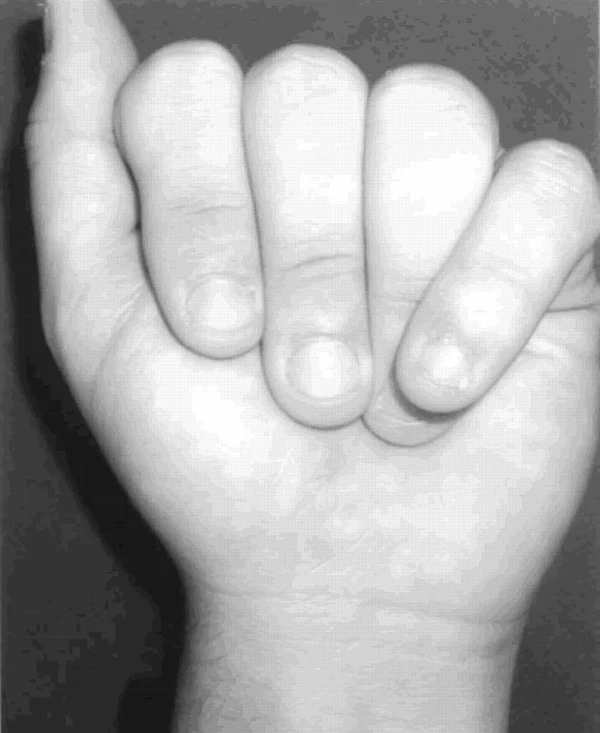
- Fingers that cross or a finger that rotates when you make a fist
- You cannot bend a finger or close the hand
- An open wound over the fracture, or numbness in the finger
- Pain or stiffness that continues weeks after an injury you took for a sprain
An X-ray alone may not show rotation of a fracture. The finger is examined as it bends, to check that all the fingers point together towards the wrist without crossing.
Why careful treatment from the start matters
The bones of the hand are small, and delicate tendons and ligaments glide over them, so any lack of care in treatment shows straight away as stiffness or weakness. Stiffness after injury is described as one of the most disabling complications of phalangeal fractures [1].
Rotation of a fracture is a problem that does not always show on X-ray: it is estimated that only 5 degrees of rotation can produce about 1.5 cm of overlap between a finger and its neighbour [2]. If the fracture heals like that, the bone may need to be cut and corrected, which is a harder operation and can itself cause stiffness [1].
The aim is therefore an accurate diagnosis from the beginning, fixation that allows early movement whenever possible, and follow-up with X-rays and hand therapy.
A quick guide to hand fractures
A summary of each type, with details in the paragraphs that follow. The final decision depends on examination and X-rays.
| Usual treatment | When is surgery considered? | Key point | |
|---|---|---|---|
| Fifth metacarpal neck (boxer's fracture) | A splint and early movement in most cases | Rotation, a large angle that cannot be reduced, an open fracture or multiple fractures | Similar results with non-surgical and surgical care in the studies [4][5] |
| Metacarpal shaft | A splint, or fixation if unstable | Displacement, shortening or rotation | Rotation matters more than angle |
| Bennett fracture (base of the thumb) | Reduction of the joint, then wires or screws | A displaced fracture in the joint | The aim is an accurate joint surface [6] |
| Proximal phalanx | A splint, or fixation with wires, screws or a plate | Unstable, displaced or rotated fracture | Most prone to stiffness and rotation |
| Middle phalanx | A splint or fixation | Joint fracture, displacement or rotation | Lies close to the flexor and extensor tendons |
| Distal phalanx (fingertip) | A splint, with care of the nail and wound | Large displacement or a joint fracture | Often comes with a nail bed injury |
| Proximal interphalangeal (PIP) joint dislocation | Reduction, then a splint and early movement | A large joint fracture or instability | Stiffness is the greater risk than instability [8][9] |
| Last-joint dislocation and mallet finger | Reduction, then a continuous splint | A large displaced fragment or instability | Splint for six to eight weeks [10] |
Fifth metacarpal neck fracture (boxer's fracture)
This usually happens after punching with a closed fist, and the fracture is in the neck of the metacarpal behind the little finger, with a flattened knuckle. Most are treated with a splint and early movement.
The evidence here is limited: a Cochrane review included five small trials (252 patients), most of poor quality, and none measured hand function [3]. A literature review reported similar patient satisfaction with non-surgical and surgical care, with surgery giving less residual angulation but a longer rehabilitation and time off work [4]. In a randomised trial of 90 patients, functional and X-ray results were satisfactory and comparable between a splint and fixation with wires [5].
Reported reasons for surgery include an open fracture, rotation, an angle above 70 degrees that cannot be reduced, and multiple metacarpal and phalangeal fractures [4].
Metacarpal shaft fractures
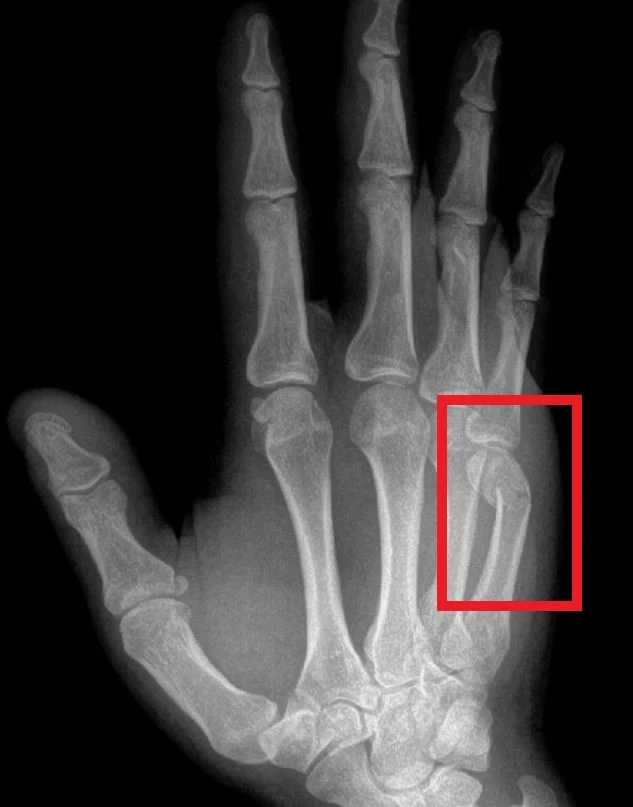
They happen after a crush, a twist or a blow, and may be transverse, oblique or spiral. What matters in these fractures is rotation and shortening: slight displacement does not always matter, but rotation makes the fingers cross.
Stable fractures are treated with a splint and early movement. Displaced, unstable or multiple fractures are fixed with wires, screws or small plates that allow the fingers to move early.
Metacarpal base fractures and carpometacarpal dislocation
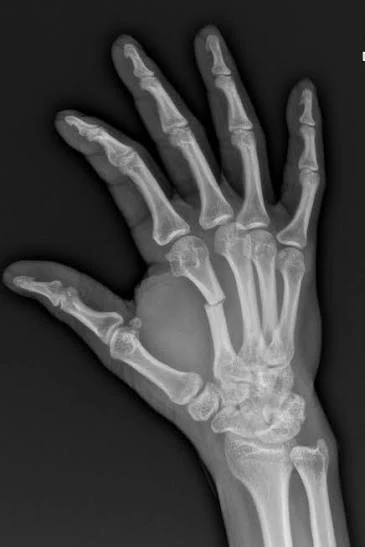
These occur at the base of the fourth and fifth metacarpals where they meet the wrist, often after a blow or a fall, and they are easy to miss on the first X-ray. The fracture may come with a joint dislocation that needs an accurate reduction.
Undisplaced fractures are usually treated with a splint. Displaced fractures, or those with a dislocation, need reduction and fixation because instability weakens the grip.
Bennett fracture and Rolando fracture at the base of the thumb
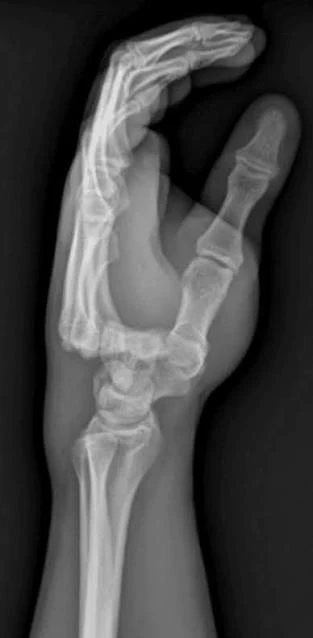
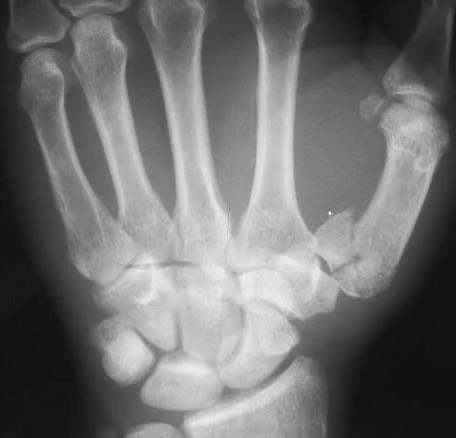
A Bennett fracture is a fracture at the base of the thumb metacarpal that enters the joint with the wrist: a small piece of bone stays in place while the muscles pull the main part away. A Rolando fracture is a comminuted fracture inside the joint at the same site, and is harder to treat.
The main aim is to reduce the joint surface accurately and hold it, because residual displacement is linked with arthritis of the joint later. Wires through the skin, screws or plates are used depending on the fracture. Reviews do not recommend one method for everyone because the studies are small and varied [6], and the evidence comparing a splint with surgery for undisplaced fractures is weak [7].
Proximal phalanx fractures
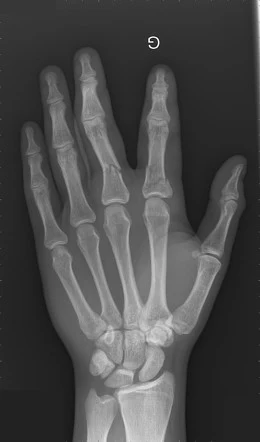
The most commonly fractured phalanx, and also one of the most prone to stiffness because the flexor and extensor tendons glide directly over it. The fractures may be transverse, oblique, spiral or into the joint.
Stable undisplaced fractures are treated with a splint and early movement. Oblique or spiral fractures, displaced ones, or those with rotation, need fixation with wires, screws or a plate. Extensive surgery can itself cause adhesions, so less invasive techniques are preferred when possible [1].
Middle phalanx fractures
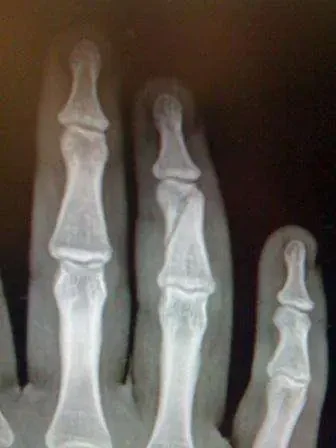
They usually follow a crush or a twist. A fracture near the joint can affect its stability, and one in the shaft lies close to the flexor digitorum superficialis tendon and the extensor tendon.
A stable fracture is treated with a splint and early movement, and a displaced, joint or rotated fracture is fixed.
Distal phalanx fractures (fingertip)
They usually happen when a finger is crushed in a door or machine. They often come with a wound of the nail bed or skin, which matters as much as the fracture because the shape and growth of the nail depend on it.
Cleaning the wound, repairing the nail bed when needed, and a splint are usually enough. Large displaced fractures, or those entering the joint, are fixed.
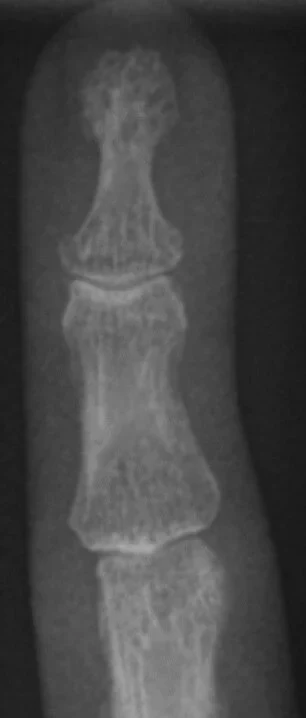
Proximal interphalangeal (PIP) joint dislocation and fracture-dislocation
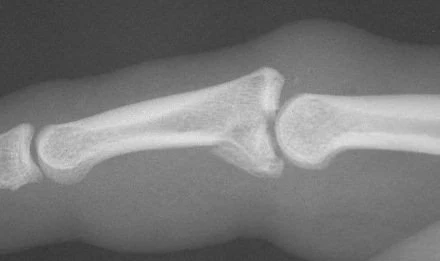
This joint is often dislocated in sport. A simple dislocation is reduced easily and then the stability of the joint is checked. A fracture at the base of the middle phalanx may come with it and tear the volar plate, the ligament on the palm side.
A simple dislocation is splinted and then movement starts early. For a fracture-dislocation the plan depends on how much of the joint surface is broken: in the reviews a small fragment is treated with a splint that blocks full straightening but allows bending, and a large fragment needs surgery, although the cut-offs differ between sources [8]. One comparison suggests early active movement with such a splint does better than a fixed splint and avoids a bent-finger stiffness [9].
The main long-term problem is stiffness and pain more than instability [8], so this joint is not left to stiffen, and is followed with X-rays and hand therapy.
Last-joint dislocation and mallet finger
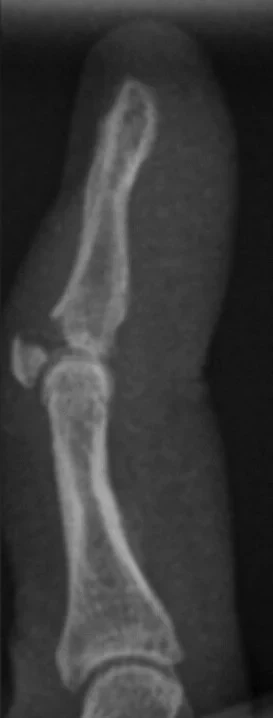
Dislocation of the last joint is relatively rare, and is reduced then splinted. A bony mallet injury is a small fracture at the base of the distal phalanx with a tear of the extensor tendon, so the tip does not straighten.
It is treated with a continuous splint that keeps the joint straight for about six to eight weeks, and surgical fixation is discussed if the fragment is large or displaced [10]. The patient's adherence to the splint is the main factor.
Metacarpophalangeal (MCP) joint dislocation
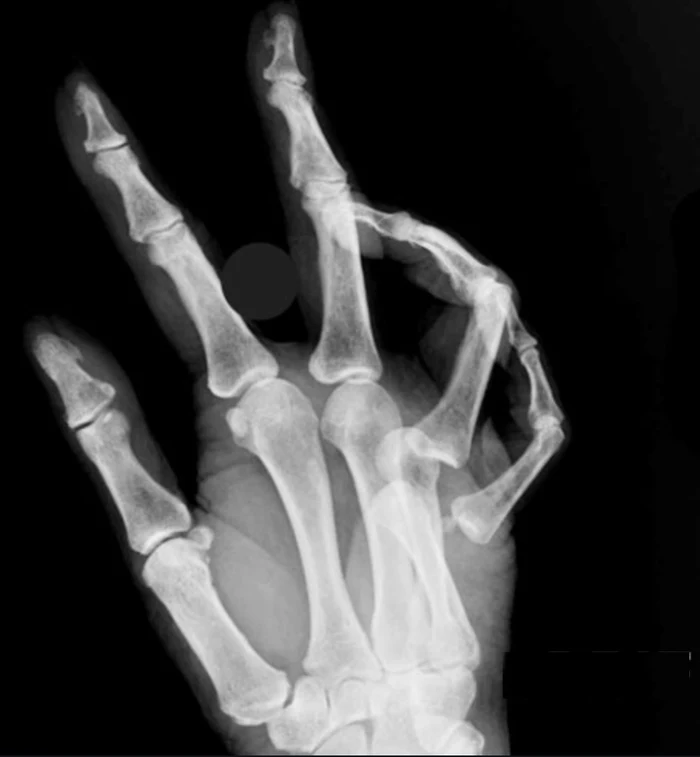
It most often affects the thumb and index finger after a fall, and the phalanx sits towards the back. A simple dislocation is reduced without surgery; in a complex dislocation soft tissue is trapped inside the joint and it can be reduced only by an operation.
Forceful repeated attempts at reduction should be avoided, because they can turn a simple dislocation into a complex one.
What if treatment was late or poor?
If a fracture healed in the wrong position or did not heal, or the joint stayed stiff after injury, there are solutions but they are harder. It is far better to have the right treatment from the beginning.
Malunion
The bone may need to be cut and corrected with new fixation, especially when rotation interferes with the grip.
Non-union
Less common in the hand, linked to open fractures, infection and poor fixation. A bone graft and fixation may be needed.
Stiff joints and tendons
Intensive hand therapy, and sometimes an operation to release adhesions and joints, with less predictable results.
What to expect during and after treatment
Durations are approximate and vary from fracture to fracture.
- First daysA splint, keeping the hand raised, and moving the uninjured fingers from day one.
- First weeksFollow-up X-rays to confirm the fracture is stable, and early movement in most fractures.
- Hand therapyExercises to regain movement and strength. It is a core part of treatment, not an add-on.
- Return to work and sportAfter healing is confirmed, with timing that varies from fracture to fracture.
Frequently asked questions
Does every hand fracture need surgery?
No. Many stable fractures are treated with a splint and early movement. Surgery is discussed for displacement, rotation, instability, an open fracture or a fracture in a joint.
How do I know if my finger is rotated?
Bend the fingers together into a loose fist: they should all point towards the wrist without crossing. Any crossing or overlap needs an examination.
Is an X-ray enough to diagnose a fracture?
An X-ray is essential but it does not show everything. The finger is examined clinically, and extra views or repeat X-rays after some days may be needed.
It has been weeks since the fracture and my finger is still stiff. What should I do?
The finger is examined and the X-rays reviewed. Intensive hand therapy may be enough, or an operation may be needed to release adhesions or to correct a fracture that healed in a poor position.
When can I go back to work?
It depends on the work, the fracture and the treatment. Your surgeon will set the right time for your case.
Dr Abdullah AlQaseer
Consultant orthopedic, hand and microsurgeon, with a hand surgery fellowship from Leeds (UK) and the Kuwait Board in Orthopedic Surgery, and seventeen years of experience. I see patients at As-Salam Hospital – Capital.
Do not ignore a hand injury, even a simple-looking one
You can book an examination by calling the As-Salam Hospital – Capital call center.
This content is for general information and does not replace a medical examination. Results vary from patient to patient and nothing is guaranteed.
Scientific references
- Minimally invasive corrective derotational osteotomy for proximal phalanx malrotation. Acta Orthop Belg. 2023;89(4).
- Malunion and nonunion of the fingers and hand (review chapter).
- Interventions for treating fractures of the fifth metacarpal neck. Cochrane Database Syst Rev (CD003210).
- Management of fifth metacarpal neck fracture (boxer's fracture): a literature review. Cureus. 2020.
- Conservative treatment versus transverse pinning in fifth metacarpal neck fractures in active adults: a randomized controlled trial.
- Systematic review of treatment methods for Bennett's fracture. Arch Bone Jt Surg.
- Little evidence for conservative or operative management of undisplaced Bennett's fractures. BestBets.
- Fracture-dislocation of the proximal interphalangeal joint: classification and treatment (review).
- Proximal interphalangeal joint dislocations: early motion with a dorsal block splint (Sports Medicine Review).
- Interventions for treating mallet finger injuries. Cochrane Database Syst Rev (CD004574).