
Wrist pain? where it hurts points to the cause
The wrist is a complex joint of eight small bones with many ligaments and tendons, so wrist pain has many causes. Learn the most common ones by where it hurts: De Quervain tenosynovitis, scaphoid fracture, thumb base (CMC) arthritis, TFCC tear and more, and when an early examination is needed.
- Consultant orthopedic and hand surgeon
- Hand surgery fellowship – Leeds, UK
- Kuwait Board in Orthopedic Surgery
 Book your appointment atAs-Salam Hospital – Capital

When should wrist pain be checked?
Many wrist pains settle with rest, but some need an early examination so they do not get worse.
- Wrist pain after a fall on the hand, especially tenderness on the thumb side
- Wrist pain lasting more than two weeks despite rest
- Pain when gripping, twisting the forearm or pressing on the hand
- Clicking or a feeling of instability in the wrist
- Swelling or a lump at the wrist
- Numbness in the fingers or a weak grip
- Wrist pain that wakes you at night
Do not ignore wrist pain after a fall even if the first X-ray looks normal. Some scaphoid fractures are not visible in the first two weeks, and delay in treating them can affect healing.
Why does wrist pain have so many causes?
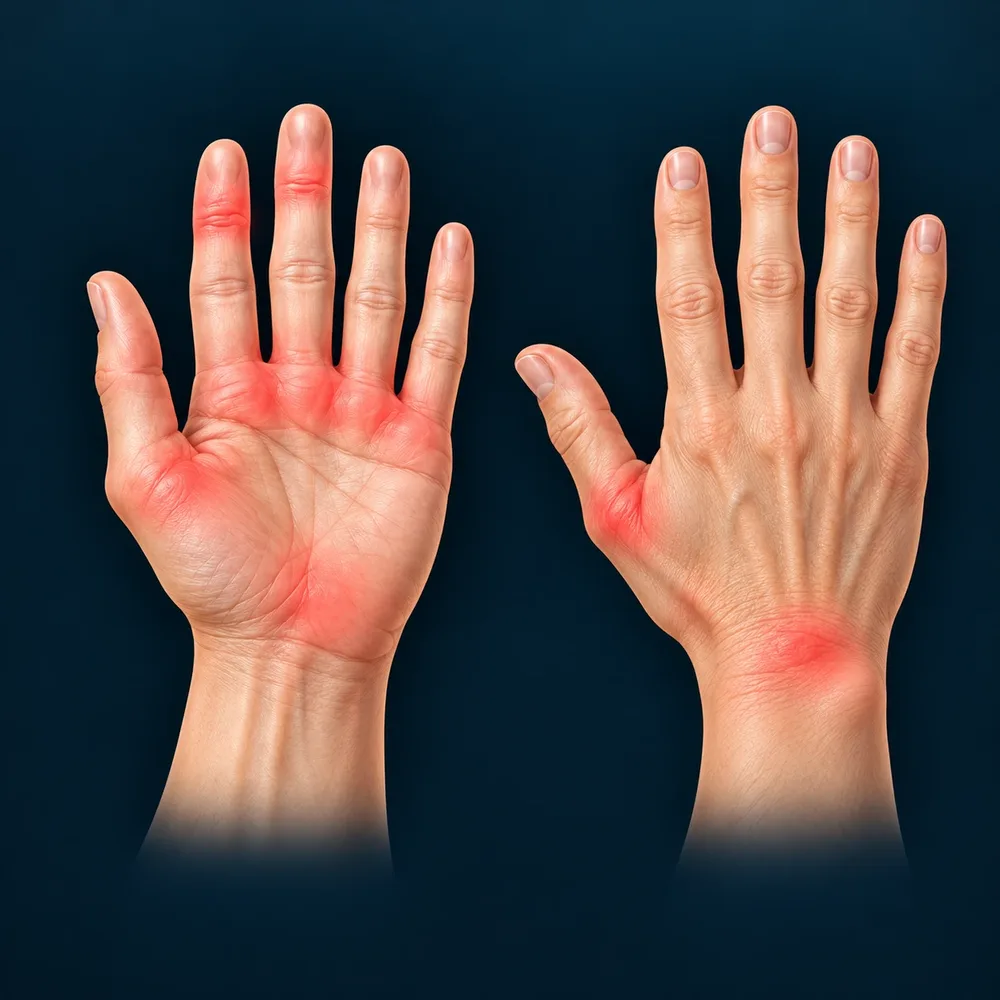
The wrist brings together eight small bones that glide on each other, ligaments that hold them, tendons that cross over them, nerves that pass through, and a cartilage complex on the little-finger side that absorbs load. A problem in any of these can cause wrist pain, so where it hurts and what it feels like often points to the likely cause.
Diagnosis starts with an examination and questions about the injury, work and activities, then an X-ray, sometimes with an MRI, ultrasound or CT, and in a few cases wrist arthroscopy (a keyhole look into the joint) to see the problem directly and treat it at the same time.
Where does your wrist hurt? The commonest causes by location
A general guide that does not replace an examination. Full details of each condition follow below.
| Where it hurts | What marks it out | Usual first steps | |
|---|---|---|---|
| De Quervain tenosynovitis | Thumb side of the wrist | Pain on gripping and moving the thumb, sometimes swelling | Thumb splint, steroid injection, and a small operation if symptoms persist [1] |
| Scaphoid fracture | Thumb side, tender in the hollow seen when the thumb is raised | Pain after a fall on the hand, and it may not show on the first X-ray | A cast or surgery, depending on the site and displacement [4] |
| Thumb base (CMC) arthritis | Base of the thumb at the wrist | Pain on pinching and opening jars, with swelling or a change in the joint's shape | Splint, injection and exercises, then an operation if these fail [2] |
| TFCC tear | Little-finger side | Pain turning the forearm, clicking, and pain carrying things | Rest and a splint, then arthroscopy if symptoms persist [3] |
| Wrist ganglion cyst | Usually the back of the wrist | A lump that can change in size and may be painful | Observation, and removal if painful or bothersome |
| Scapholunate ligament injury | Middle of the back of the wrist | Pain and clicking after an injury, with a weak grip | Immobilisation or surgery, depending on severity |
| Carpal tunnel syndrome | Palm side, with the fingers | Numbness, especially at night, and a weak grip | Night splint, injection, and an operation if symptoms persist |
A note: the evidence for some of these treatments is limited, and the details are given in each section below. This page is for information and does not replace a medical examination.
De Quervain tenosynovitis: symptoms and treatment
What is it? De Quervain tenosynovitis is inflammation and tightening of the sheath that two thumb tendons run through at the thumb side of the wrist. It causes pain on the thumb side of the wrist that is worse when gripping, lifting a child or using a phone.
Who gets it? It is commoner in women between thirty and fifty, in new mothers during pregnancy and breastfeeding, and in people who use the thumb repeatedly at work, on the phone or in games. It can also follow a direct injury to the wrist.
Symptoms: pain, swelling and tenderness on the thumb side of the wrist, with difficulty pinching and holding, and the pain may spread up the forearm. The diagnosis is confirmed by a simple examination test (the Finkelstein test), and an X-ray is often not needed.
Treatment: it starts with a splint that rests the thumb and wrist and reduces the painful movement. A steroid injection is used in many cases, and a pooled analysis found improvement with injection [1], although those studies did not always compare it with a splint alone. When symptoms persist or return, a small operation under local anaesthesia opens the tight sheath, and patients return to light use of the hand within days.
Scaphoid fracture: symptoms, diagnosis and treatment
What is it? The scaphoid is one of the eight wrist bones and the one that breaks most often. The fracture usually follows a fall onto an outstretched hand, and the pain can seem mild, so it is often mistaken for a simple sprain.
Symptoms: pain and swelling on the thumb side of the wrist, tenderness in the hollow seen when the thumb is raised, and a weak grip. In some cases the fracture does not show on the first X-ray, so the X-ray is repeated after two weeks or an MRI or CT scan is requested.
Why not ignore it? Parts of the scaphoid have a poor blood supply, and delay in treatment can lead to non-union or damage to the bone, and later to wrist arthritis.
Treatment: it depends on the site of the fracture and how far it is displaced. A large trial (SWIFFT) found no important difference between a cast and screw fixation after follow-up for undisplaced or minimally displaced waist fractures [4], while displaced fractures or those near the upper end need careful assessment and may need surgery. If a fracture does not heal, bone grafting is discussed.
Thumb base (CMC) arthritis: symptoms and treatment
What is it? Arthritis of the joint that joins the base of the thumb to the wrist bone, the joint that takes most of the load when pinching and gripping. Its cartilage wears with time.
Who gets it? It usually appears after forty, is commoner in women, and affects people who pinch forcefully and repeatedly.
Symptoms: pain at the base of the thumb on opening jars, holding keys or writing, with weak pinch, swelling, a gradual change in the shape of the thumb base and morning stiffness.
Treatment: it starts with a thumb-base splint, painkillers, exercises and changing how objects are held, and injections are used when pain increases. The best current evidence supports splints and injections, although the quality of the studies is moderate [2]. Surgery, such as removing the affected bone with ligament reconstruction, is discussed when non-operative treatment fails.
TFCC tear: pain on the little-finger side of the wrist
What is it? The triangular fibrocartilage complex (TFCC) is a structure of cartilage and ligaments on the little-finger side of the wrist that stabilises the two forearm bones and absorbs load. It tears with a fall or sudden twist of the wrist, or wears gradually with age.
Symptoms: pain on the little-finger side of the wrist that increases with turning the forearm, carrying things or leaning on the hand, sometimes with clicking and a feeling of instability. X-rays and MRI, sometimes with contrast, help the diagnosis, and arthroscopy sometimes settles it.
Treatment: for tears without instability, rest, a splint and hand therapy are a reasonable first step, although the studies are few and mixed [3]. When symptoms persist, wrist arthroscopy is done to repair the cartilage if it can be repaired, or to clean it up, and sometimes the forearm bone is shortened if it is rubbing on the wrist bones.
Wrist ganglion cyst: a lump on the wrist
What is it? A benign cyst filled with jelly-like fluid, usually on the back of the wrist and sometimes on the palm side. It is not a tumour and does not turn into one.
Symptoms: a lump that may change in size and may not hurt at all, though it can cause pain, a weak grip or pressure on a nerve. Sometimes the cyst is too small to see yet painful, and ultrasound or MRI shows it.
Treatment: if it causes no problem, observation is enough, as some disappear by themselves. If painful or bothersome, the lump is removed surgically or by arthroscopy, and the chance of recurrence is discussed, because cysts can come back after removal or needle aspiration.
Scapholunate ligament injury and wrist instability
What is it? The scapholunate ligament joins two bones in the middle of the wrist. It tears with a fall onto the hand or a severe twist, and the injury may be overlooked because it looks like a simple sprain.
Symptoms: pain in the middle of the back of the wrist, clicking, a weak grip, and pain on pressing the wrist. If untreated, the movement of the wrist bones can change with time and lead to arthritis.
Diagnosis and treatment: examination and X-rays, then MRI or arthroscopy. Options range from immobilisation and hand therapy for mild injuries to ligament repair or reconstruction for more severe ones, and in late stages wrist salvage operations may be discussed.
Carpal tunnel syndrome: wrist pain with numb fingers
What is it? Pressure on the median nerve inside the carpal tunnel on the palm side of the wrist. It causes numbness and tingling in the thumb, index and middle fingers, worse at night or when driving or holding a phone.
Treatment: a night splint, avoiding positions that bring on the symptoms, and an injection if needed. If symptoms persist or the muscles weaken, a carpal tunnel release is done, a short operation under local anaesthesia. See the carpal tunnel syndrome page for details.
Other causes of wrist pain
Less common causes include tendinitis of the tendon on the little-finger side (ECU tendinitis), intersection syndrome on the back of the forearm near the wrist, Kienbock disease (loss of blood supply to the lunate bone), arthritis of the wrist after an old fracture or injury, impaction of the forearm bone against the wrist bones, inflammatory arthritis such as rheumatoid arthritis and gout, and fractures of the radius near the wrist.
That is why guessing the cause is not enough. If the pain persists or affects your work or sleep, an examination and X-rays decide the most suitable treatment.
When is wrist arthroscopy or surgery needed?
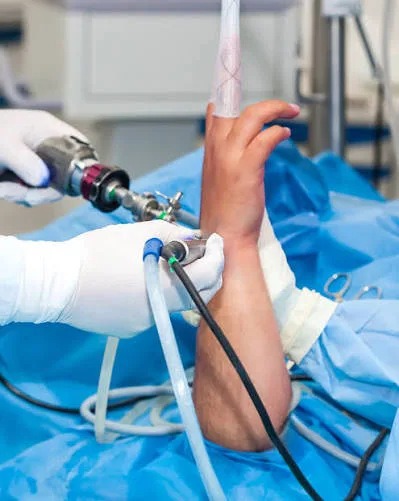
Most wrist pain is treated first with rest, a splint, hand therapy and sometimes an injection. Surgery is discussed when pain continues despite suitable treatment, or when there is a fracture, tear or instability that needs repair.
Wrist arthroscopy allows some conditions, such as TFCC tears and some ligament injuries, to be treated through small openings. Treatment is chosen once the cause is clear, because no single treatment suits every wrist pain.
What happens after the examination?
Steps vary with the cause.
- ExaminationA clinical examination and X-rays, with an MRI, ultrasound or CT added if needed to find the cause.
- First treatmentRest, a splint and changing the painful movement, sometimes an injection or hand therapy.
- If surgery is neededThe operation is chosen by the diagnosis, by arthroscopy or a small cut, followed by gradual rehabilitation.
- Return to activityVaries from case to case and depends on how the fracture, cartilage or tendon heals.
Frequently asked questions
What are the most common causes of wrist pain?
The commonest are De Quervain tenosynovitis, scaphoid fracture after a fall, thumb base (CMC) arthritis, TFCC tear, wrist ganglion cyst, ligament injuries and carpal tunnel syndrome. Where it hurts and what it feels like point to the likely cause.
How do I know if my wrist pain is a fracture?
Pain after a fall, especially with tenderness on the thumb side, calls for examination and an X-ray. The first X-ray is sometimes not enough, so it may be repeated after two weeks or an MRI done.
How can I tell De Quervain from a scaphoid fracture?
Both cause pain on the thumb side of the wrist. A fracture usually follows a fall or injury, while tendon inflammation follows repeated use. An examination and X-ray tell them apart.
Does all wrist pain need an operation?
No. Most cases improve with rest, a splint, hand therapy or injections, and surgery is kept for cases that do not improve or that have a fracture or tear needing repair.
Does De Quervain go away by itself?
Mild cases may settle with rest and a splint, and if it persists there is an injection or a small operation to open the sheath.
Do I need an MRI for wrist pain?
Not always. It is requested when examination and X-rays are not enough to find the cause, as with TFCC tears, ligament injuries and some hidden fractures.
Is a lump in the wrist a tumour?
Usually not, as a ganglion cyst is the commonest lump. Any lump is still worth examining to confirm what it is.
When is wrist arthroscopy done?
When pain continues despite non-operative treatment, or when a cartilage or ligament tear needs to be seen directly or repaired.
How do I book an examination for wrist pain in Kuwait?
You can call the As-Salam Hospital – Capital call center on 1830003 to book an appointment with Dr Abdullah AlQaseer, consultant orthopedic and hand surgeon.
Dr Abdullah AlQaseer
Consultant orthopedic, hand and microsurgeon, with a hand surgery fellowship from Leeds (UK) and the Kuwait Board in Orthopedic Surgery, and seventeen years of experience. I see patients at As-Salam Hospital – Capital.
Do not ignore wrist pain that keeps coming back
You can book an examination by calling the As-Salam Hospital – Capital call center.
This content is for general information and does not replace a medical examination. Results vary from patient to patient and nothing is guaranteed.
Scientific references
- Richie CA, Briner WW. Corticosteroid injection for treatment of de Quervain's tenosynovitis: a pooled quantitative literature evaluation. J Am Board Fam Pract. 2003.
- Nonoperative management of trapeziometacarpal joint arthritis: a systematic review of the clinical trials. Cureus. 2024.
- The natural history of non-operatively treated traumatic triangular fibrocartilage complex tears: a systematic review. J Wrist Surg. 2024.
- Dias J, et al. Scaphoid waist internal fixation for fractures trial (SWIFFT): a multicentre, pragmatic, parallel-group, randomised controlled trial. Lancet. 2020;396:390-401.