
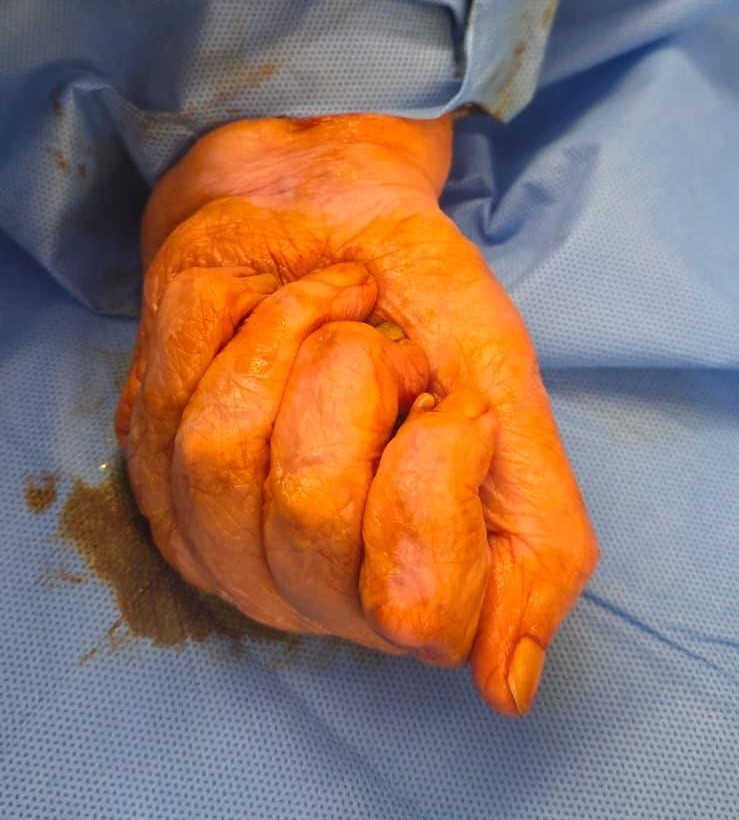
Before release: the fingers locked in a tight fist.
A woman came to me after a stroke that left her with right-sided hemiplegia and severe spasticity of the upper limb. Her fingers were locked in a tight flexed fist. This was more than a cosmetic or functional problem:
- The palm could not be opened, so hygiene was nearly impossible.
- Skin maceration led to a fungal infection of the hand.
- The position was painful, and the pain was constant.
Video before the release.
The problem
In spastic hemiplegia, the long finger flexors (flexor digitorum superficialis and profundus) are overactive and gradually shorten. Once the fingers are fixed in flexion, nursing care, skin hygiene and comfort all suffer. The treatment goal is often passive function: an open, clean, pain-free hand. Active grasp is usually not the aim.
The technique
Open tendon lengthening is one option, but a documented minimally invasive alternative is percutaneous needle release (needle tenotomy) of the flexor tendons. Using a needle inserted through the skin, the tight tendons are divided at selected levels. Their length is then restored by gentle passive extension.
Advantages:
- No open incision and a minimal wound
- Lower risk of wound problems, which matters in a hand with skin compromise
- A quick procedure
- Fast recovery and early splinting
The result
Immediately afterwards, the fingers extended passively and the palm opened fully. The skin could be cleaned and dried, and the pain settled.
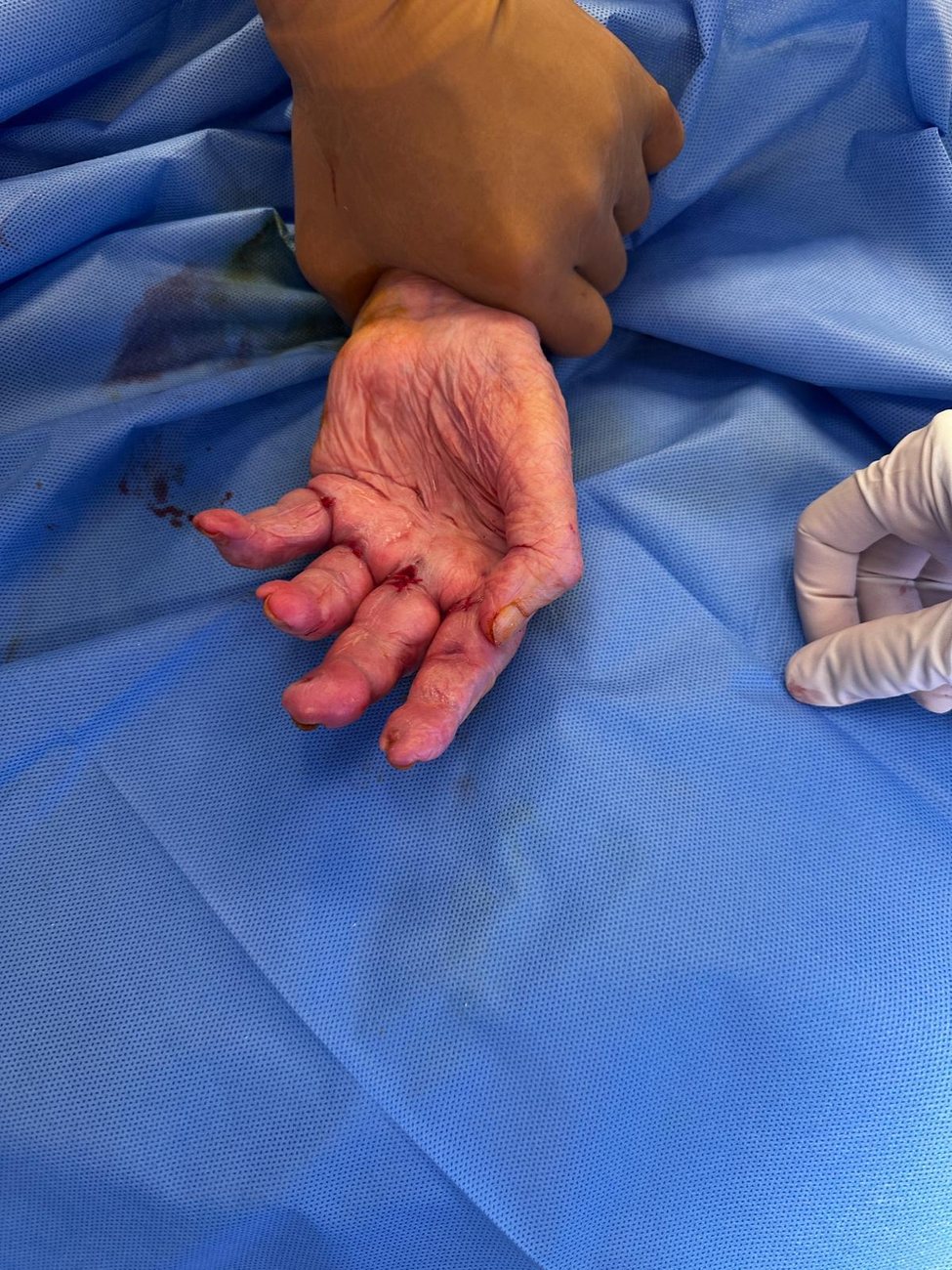
After release: the palm opens fully.
Take-home message
For the severely spastic, clenched hand after stroke, needle release of the flexor tendons is a simple, low-morbidity option that can restore hygiene, relieve pain and prevent skin complications.
Cases are published with the patient's consent and without anything that identifies them. Results differ from patient to patient.
← All cases