
A young athlete came to me after an injury to his hand. He had severe pain and could not move his middle finger at all. The finger was locked.
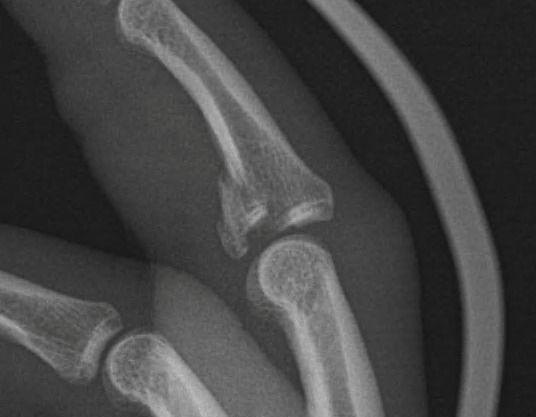
X-ray before the operation.
What the X-ray showed
On careful study of the X-ray, there was a fracture at the base of the middle phalanx, the middle bone of the finger, right at the joint. There was also a subtle subluxation of the joint, meaning the joint surfaces were no longer sitting properly against each other. This is shown by the "V" sign: where a healthy joint has an even gap between its surfaces, here the gap opens in the shape of a "V".
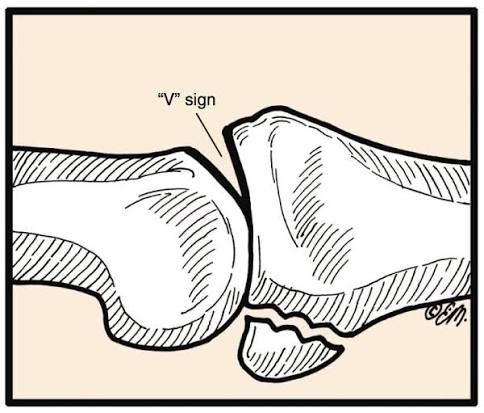
Illustration of the "V" sign: the V-shaped opening of the joint shows that it is subluxated.
The "V" sign explains why he could not move his finger. A small, subtle sign like this can be easy to miss, which is why a finger that will not move after an injury deserves a careful look at the X-ray and not just a diagnosis of a sprain.
Choosing the treatment
A fracture-dislocation like this can be treated with different techniques described in the medical literature. Some are open, where the surgeon opens the finger to reduce the fracture, and some are closed. I chose to reduce and fix it with the percutaneous technique described by Vitale and colleagues in 2011. Through tiny skin punctures, the broken fragment is guided back into position under X-ray, held with thin wires, and an extra wire is placed so that the joint cannot slip out again.
I was able to achieve a congruent joint, with the joint surfaces fitting together properly again, without opening up the fracture.
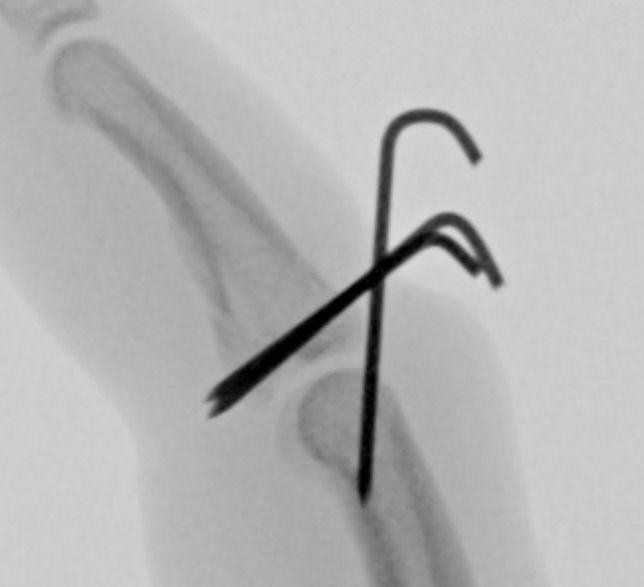
X-ray during the operation, showing the wires.
After the operation
The wires were removed after four weeks. At that point, forceful manipulation of the finger was done under local anesthesia, as described in the paper. During the weeks of immobilization, scar bands called adhesions form around the tendons and stiffen the finger; breaking them at once lets the finger start moving.
The result
Fortunately, the patient gained back his range of motion almost to a normal level, and he was very happy with the result.
Reference: Vitale MA, White NJ, Strauch RJ. A percutaneous technique to treat unstable dorsal fracture-dislocations of the proximal interphalangeal joint. J Hand Surg Am. 2011;36(9):1453-1459.
Cases are published with the patient's consent and without anything that identifies them. Results differ from patient to patient.
← All cases