
Carpal tunnel syndrome treatment in Kuwait
Numbness or tingling in your fingers, especially at night? Understand the cause, your treatment options, and an honest comparison of open, endoscopic and ultrasound-guided release, based on the studies, not the marketing.
- Consultant orthopedic and hand surgeon
- Hand surgery fellowship – Leeds, UK
- Kuwait Board in Orthopedic Surgery
 Book your appointment atAs-Salam Hospital – Capital

Are these your symptoms?
These are the most common signs of carpal tunnel syndrome. Having some of them does not prove the diagnosis, but it is reason enough to be examined.
- Numbness, tingling or "pins and needles" in the thumb, index, middle and half of the ring finger (the little finger is usually spared)
- It wakes you at night, and you shake or move your hand to ease the feeling
- Symptoms worsen when driving, holding a phone or working at a computer
- A weak grip, or dropping things without meaning to
- Difficulty with fine tasks such as buttoning a shirt or picking up coins
- Wrist pain that may spread up the forearm
If you notice wasting of the muscle at the base of your thumb, or permanent loss of feeling, the pressure on the nerve may be advanced. Do not wait.
What is carpal tunnel syndrome?
At the wrist there is a narrow passage called the carpal tunnel. The wrist bones form its floor and a strong fibrous ligament forms its roof. Through it runs the median nerve, which gives feeling to the fingers and powers the thumb muscles, together with nine tendons that bend the fingers.
When this passage narrows or what is inside it swells, pressure on the nerve rises and its blood flow falls. Symptoms appear first at night, then during the day, and if neglected the nerve can be permanently damaged.
Who is more likely to get it?
- Women, and people between 40 and 60
- People with diabetes or an underactive thyroid
- Pregnancy (symptoms often settle after delivery)
- Obesity, and repetitive wrist work or vibrating tools
- A previous wrist fracture
Carpal tunnel syndrome
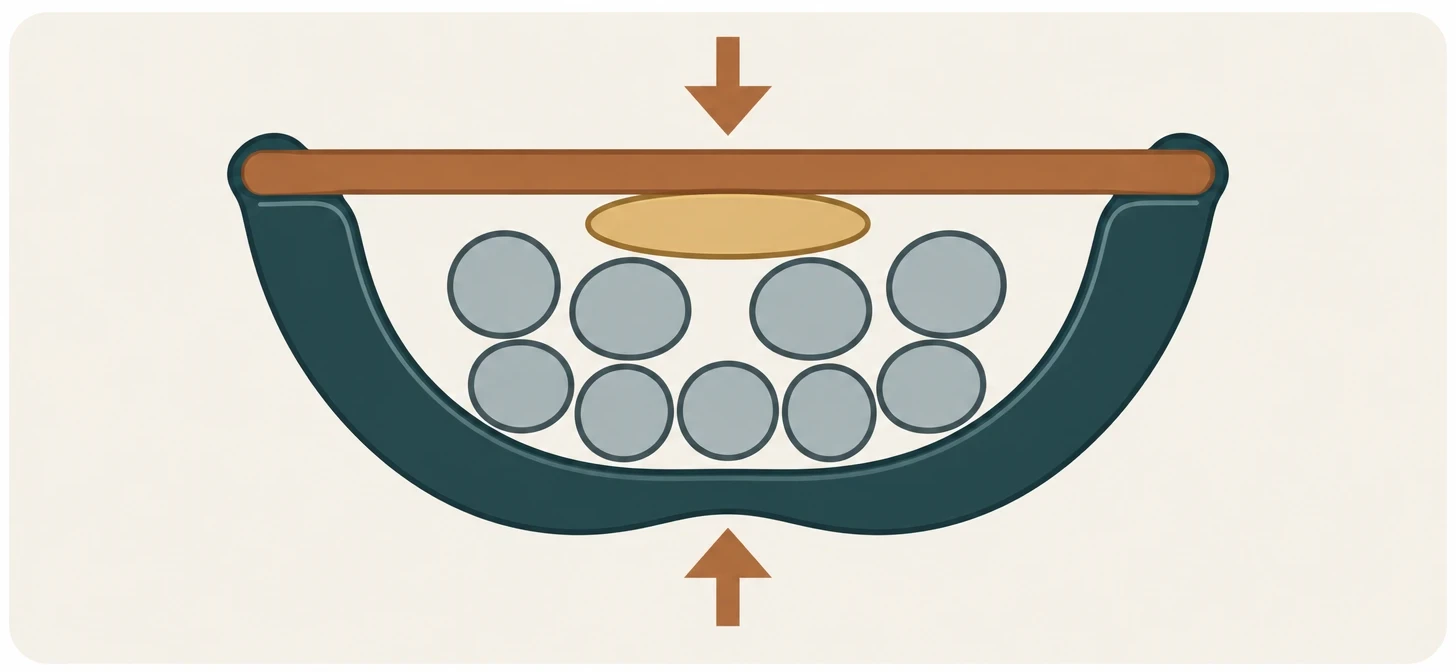
- Median nerve
- Tendons
- Transverse carpal ligament
- Carpal bones
How is it diagnosed?
Diagnosis rests mainly on your history and examination (for example the Phalen, Tinel and carpal compression tests). A nerve conduction study or an ultrasound may be requested when the diagnosis is unclear, symptoms are severe, or before surgery. Not every hand numbness is carpal tunnel syndrome, so the right diagnosis is the first step to the right treatment.
Treatment, step by step
Not every case needs surgery. We start with the least invasive option that suits your case.
Night splint and activity changes
A splint that keeps the wrist straight during sleep, avoiding movements that bring on symptoms, and treating contributing conditions such as diabetes. Suits mild, recent cases and pregnancy.
Steroid injection
It can ease symptoms for a limited time, but it does not remove the cause of the pressure and symptoms often return, so it is not a permanent solution.
Carpal tunnel release surgery
When symptoms persist or get worse, when weakness or wasting appears, or when non-surgical treatment has not helped. The ligament that is pressing on the nerve is divided, widening the passage and freeing the nerve.
What does the evidence say? A recent Cochrane review (2024) of 14 randomized trials found that surgery roughly doubled the chance of clinical improvement in the long term compared with splinting, and far fewer people needed further surgery after the first operation. Comparison with steroid injection is inconclusive. [1]
Open, endoscopic or ultrasound-guided release?
All three share the same aim: dividing the transverse carpal ligament to relieve pressure on the nerve. They differ in method and incision size, and this is what the studies say about them.
| Open release | Endoscopic release | Ultrasound-guided | |
|---|---|---|---|
| How it is done | A small incision in the palm, with direct vision | One or two small openings and a tiny camera | A very small opening, with the instrument guided by ultrasound |
| Anaesthesia | Usually local, day case | Usually local, day case | Usually local, day case |
| Symptom relief in the long term | Good, the historical reference | Similar to open | Similar in the studies available |
| Recovery in the first weeks | Relatively slowest | Slightly faster: earlier return to work and activities [2] | Faster in three small studies [3] |
| Scar pain and tenderness | More likely | Less | Less in the studies |
| Serious complications and recurrence | Rare | Rare, with no clear difference from open; slightly more temporary tingling, fewer skin problems [2] | Rare, with no clear difference in the small studies available [3] |
| Strength of evidence | Extensive and long-term | Extensive: 27 trials in one analysis [2] | Newer and smaller: three trials, only 221 patients, from one country [3] |
The bottom line
No technique has been shown to give a better final result after some months, or fewer serious complications. The differences are in the first weeks: incision size, scar pain and how quickly you return to work.
Ultrasound-guided release has encouraging results, but the evidence is still smaller and shorter in follow-up, and it has not been compared directly with endoscopic release.
The choice depends on your case and on the surgeon's experience with the technique they master. A newer technique is not automatically a better one for you.
What matters more than the name of the technique?
What to expect after surgery
These are rough figures and vary from patient to patient and from technique to technique.
- The operationUsually short, and most often done under local anaesthetic without an overnight stay.
- The first daysMove your fingers early, keep the hand raised, and use it for light activities.
- A few weeksNight tingling usually improves quickly. Desk work can often resume after a few days to two weeks, depending on technique and job.
- Two to three monthsStrength returns gradually. In late cases nerve recovery may be slow or incomplete, which is why treatment should not be postponed for long.
Frequently asked questions
Will it go away on its own?
Mild, recent cases, and those linked to pregnancy, may settle. In many people the symptoms persist or worsen, and the longer the nerve is compressed, the greater the risk of damage.
Is the surgery safe?
It is one of the most common hand operations and serious complications are rare. As with any surgery, problems such as scar pain, temporary tingling or incomplete relief can occur, and they are discussed with you before you decide.
Can the symptoms come back after surgery?
Rarely. Causes include an incomplete release, or that the original problem was not carpal tunnel syndrome, which is why an accurate diagnosis matters.
Do I need a nerve test?
Not always. It is requested when the diagnosis is unclear, when other causes are possible, or before surgery in some cases.
When should I see a doctor?
If symptoms last more than a few weeks, keep waking you at night, or you notice a weak grip or wasting of the thumb muscle.
Dr Abdullah AlQaseer
Consultant orthopedic, hand and microsurgeon, with a hand surgery fellowship from Leeds (UK) and the Kuwait Board in Orthopedic Surgery, and seventeen years of experience. I see patients at As-Salam Hospital – Capital.
Take the first step towards ending the numbness
You can book an examination by calling the As-Salam Hospital – Capital call center.
This content is for general information and does not replace a medical examination. Results vary from patient to patient and nothing is guaranteed.
Scientific references
- Lusa V, et al. Surgical versus non-surgical treatment for carpal tunnel syndrome. Cochrane Database of Systematic Reviews. 2024;(1):CD001552.
- Vasiliadis HS, et al. Endoscopic and open release similarly safe for the treatment of carpal tunnel syndrome: a systematic review and meta-analysis. PLoS One. 2015;10(12):e0143683.
- Ekhtiari S, et al. Carpal tunnel release with ultrasound guidance versus open and mini-open carpal tunnel release: a systematic review and meta-analysis of randomized controlled trials. J Hand Surg Glob Online. 2025;7(2):121-126.