
A cut or injured nerve, timing and skill make the difference
Numbness, loss of feeling or weakness after a cut or injury? The nerve may be divided, and a divided nerve does not heal on its own. Learn the signs, when a nerve is sewn or grafted, and why this operation is done under a microscope.
- Consultant orthopedic and hand surgeon
- Hand surgery fellowship – Leeds, UK
- Kuwait Board in Orthopedic Surgery
 Book your appointment atAs-Salam Hospital – Capital

When should I suspect a cut nerve?
These signs call for an examination after any cut or injury that may involve a nerve, in the hand, arm or anywhere else.
- Loss of feeling or numbness in a finger or part of it after the cut
- You cannot feel heat, cold or a pinprick in the area
- Weakness moving the thumb or fingers, or a weak grip
- Clawing of the fingers and weak pinch when the ulnar nerve is injured
- A sharp, electric-shock pain when the wound is touched
- A cut at the wrist, forearm or anywhere else with numbness or weakness beyond it
Numbness after a cut should be treated as a nerve injury until proven otherwise. Do not wait for it to come back by itself: the later the repair, the lower the chance of recovery.
How does a nerve heal?
A nerve is a cable that carries fibres for feeling and movement. When it is cut, the fibres beyond the cut break down, and new fibres then grow slowly from the near end, at roughly one millimetre a day. Recovery can therefore take months, depending on how far the injury is from the fingertips or the muscles.
If a muscle stays without a nerve for a long time, roughly a year or more, it can lose the ability to respond even if the nerve reaches it later. That is why time is a key factor.
What decides the result of a repair?
A pooled analysis of 623 median and ulnar nerve injuries from 23 studies looked at what influences the outcome after microsurgical repair. Age, level of injury, which nerve was injured, and delay to repair all affected the result [1].
Delay to repair
The chance of successful return of movement fell by about 6% for each month of delay, and the chance of return of feeling by about 8% [1].
Age
Age was the strongest factor for return of feeling, and results in those under 16 were far better than in those over 40 [1].
Which nerve
The chance of return of movement was lower after ulnar nerve injury than after median nerve injury [1].
Level of injury
The level of the cut affects the result, which is why the surgeon assesses each injury by its site [1].
These are statistics for groups of patients, not a promise for any one person.
Direct repair under the microscope
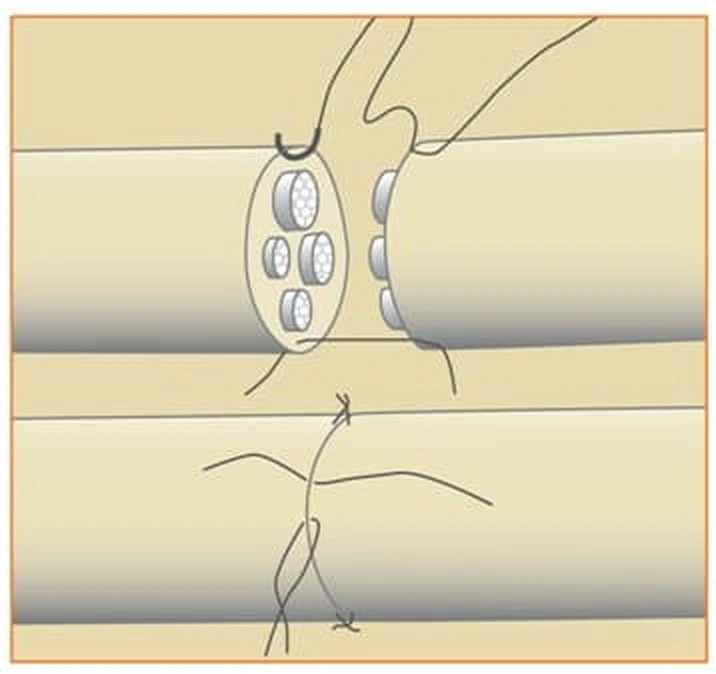
When the cut is sharp and clean and there is no gap between the ends, the nerve is sewn directly without tension. The operation is done under the surgical microscope with stitches finer than a hair, matching the bundles of fibres so that each end meets the one opposite it.
This is the part the surgeon controls, and the result of the repair depends on it: a stitch line under tension or with ends that do not match weakens healing of the fibres and can form a painful nerve lump (neuroma). That is why nerve repair needs a surgeon trained in microsurgery.
When is a nerve graft needed?
If there is a gap between the ends, pulling them together does harm, and the gap is bridged instead.
| When is it used? | Advantages | Limits | |
|---|---|---|---|
| Direct repair | A clean cut with no gap | No second surgical site | There must be no tension at all |
| Graft from the patient's own nerve | A longer gap, a ragged injury or a late repair | The reference choice for longer gaps | Taking it leaves a small area of numbness at the donor site |
| Nerve conduit (tube) | Short gaps in finger nerves | No need to take a nerve from elsewhere | Low-quality evidence; less suited to long gaps |
What does the evidence say? A systematic review of the evidence on reconstructing finger nerves described it as low-quality overall, and noted that in several small trials conduits gave results similar to grafts for short gaps [2]. The choice therefore depends on the length of the gap, the nerve involved and the state of the wound.
Late or neglected injuries
If the diagnosis was delayed, the nerve is assessed and a nerve graft may be needed. If so much time has passed that the muscles can no longer respond, tendon transfers may be discussed to restore the lost movement.
The chance of regaining feeling and movement falls with delay [1], so any numbness after a cut should be checked without waiting.
What happens after the repair?
Stages are approximate, and recovery time depends on the level of the injury.
- First weeksA splint to protect the repair from tension, then gradual movement under a hand therapist.
- After thatHand therapy and sensory re-education, gradually retraining feeling in the area.
- Following monthsThe nerve regrows step by step, and the surgeon follows the return of feeling and strength.
- In the meantimeProtect the numb area from burns and cuts, because you cannot feel them.
Frequently asked questions
Does a cut nerve heal by itself?
No. A completely divided nerve does not heal well on its own and usually needs surgical repair.
Will feeling return to normal after repair?
Feeling can improve to different degrees and may not return fully to normal. The result is affected by age, the level of injury, the nerve involved and how soon it is repaired.
Why is the operation done under a microscope?
Because the nerve is delicate and the bundles of fibres are very fine. Matching the ends accurately and sewing them without tension needs magnification and skill.
How long does recovery take?
Months, because the nerve grows slowly, and the further the injury is from the fingertip or muscle, the longer it takes.
A long time has passed since my injury. Is it too late?
The nerve is assessed first. Repair or grafting may still be possible, or other operations to restore function may be discussed, but the chance of improvement falls with delay.
Dr Abdullah AlQaseer
Consultant orthopedic, hand and microsurgeon, with a hand surgery fellowship from Leeds (UK) and the Kuwait Board in Orthopedic Surgery, and seventeen years of experience. I see patients at As-Salam Hospital – Capital.
Do not delay checking numbness after a cut
You can book an examination by calling the As-Salam Hospital – Capital call center.
This content is for general information and does not replace a medical examination. Results vary from patient to patient and nothing is guaranteed.