
Scaphoid fracture of the wrist, do not ignore it
Wrist pain after a fall on your hand? It may be a small fracture that does not show on the first X-ray. Find out why it should be checked early, how it is treated by fracture site and displacement, and what to do if it does not heal.
- Consultant orthopedic and hand surgeon
- Hand surgery fellowship – Leeds, UK
- Kuwait Board in Orthopedic Surgery
 Book your appointment atAs-Salam Hospital – Capital

When should I suspect a scaphoid fracture?
These signs call for an examination after any fall or wrist injury, even if it seemed minor.
- Pain on the thumb side of the wrist, especially when pressing the hollow at the base of the thumb
- It began after a fall onto the open palm, a sports injury or an accident
- Mild swelling or bruising of the wrist
- Pain when gripping, pinching, bending the wrist or leaning on the hand
- You thought it was a "simple sprain", but it still hurts after one or two weeks
- A weak grip and pain that returns with use
The first X-ray can look normal even when there is a fracture. If pain continues after a fall, do not rely on the first X-ray alone, and ask a hand surgeon to examine you.
Why a scaphoid fracture should not be ignored
The scaphoid is a small wrist bone, but one of the most troublesome to heal.
It may not show on the first X-ray
In some injuries the first X-ray looks normal despite a fracture. It may appear on an X-ray taken one to two weeks later, or on an MRI or CT scan.
A weak blood supply
Blood reaches the scaphoid from the far end towards the near end, so fractures near the end close to the forearm heal slowly, and that part of the bone can lose its blood supply (avascular necrosis).
Non-union can pass silently
A fracture that does not heal may not hurt much, so it is ignored for months or years until deformity or arthritis appears.
Wrist arthritis over the years
Non-union changes how the wrist moves, so arthritis and deformity (known as SNAC) develop over time, with pain and loss of motion and strength.
This is how the first X-ray after a fall can look: normal at first sight. In some injuries there is a fine scaphoid fracture that does not show on it, and the fracture line appears on an X-ray taken one to two weeks later. That is why the X-ray is repeated, or an MRI or CT scan is requested, when pain continues.
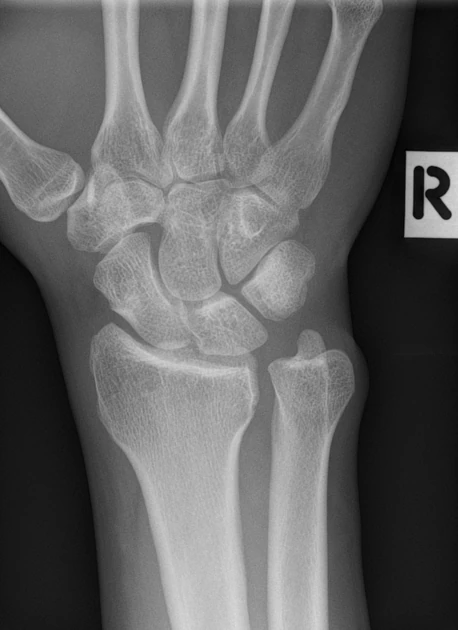
The earlier a fracture is found and treated, the better the chance that simpler treatment will heal it.
The fracture site decides the plan
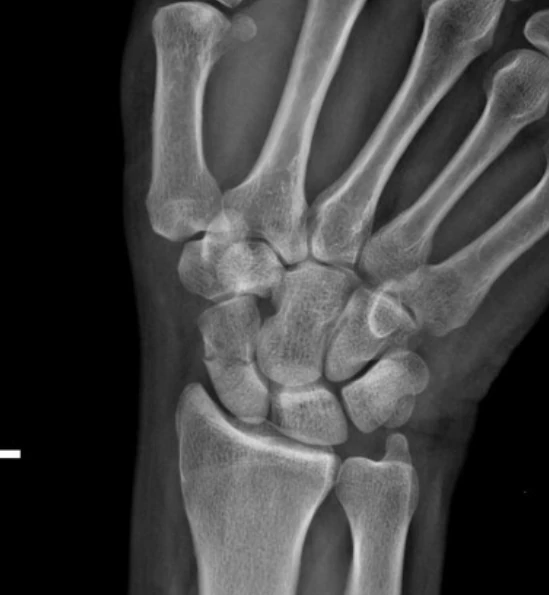
The scaphoid is divided into three zones, each with a different blood supply and chance of healing. Percentages are approximate.
The scaphoid is a small boat-shaped bone at the base of the thumb. It links the two rows of wrist bones, so it takes a lot of load when you lean on your hand. Most of its surface is covered by cartilage, so blood vessels reach it only through limited areas, which is why some fractures heal slowly.
| Distal end (tubercle) | Waist (middle) | Proximal pole | |
|---|---|---|---|
| How common | Least common, about 5–10% | Most common, about 70% | About 10–20% |
| Blood supply | Good | Moderate | Weak |
| Chance of healing | High | Good unless displaced | Lowest, with a higher risk of non-union and necrosis |
| Usual treatment | Splint or cast | Cast or screw, depending on displacement | Often surgical fixation |
Treatment by site and displacement
Displacement means how far the two parts of the bone have shifted from each other. The surgeon usually measures it on a CT scan, and the common cut-off for calling a fracture displaced or unstable is about 1 mm or more.
| Usual treatment | Approximate duration | Notes | |
|---|---|---|---|
| Distal end (tubercle), undisplaced | Splint or short cast | About 4 to 6 weeks | Usually heals well |
| Waist, undisplaced or minimally displaced | Below-elbow cast, or a compression screw through the skin | Cast usually 8 to 12 weeks; a screw allows earlier movement | Large studies found no important difference in wrist outcome between the two [1] |
| Waist, displaced or unstable | Surgical fixation with a screw, sometimes with a bone graft | Healing usually 8 to 12 weeks | A cast alone raises the risk of non-union |
| Proximal pole | Usually surgical fixation, sometimes by arthroscopy | Healing is slower and needs CT follow-up | Higher risk of necrosis and non-union |
| Old or late-diagnosed fracture | CT scan and assessment, often surgery | Depends on the case | Waiting reduces the chance of healing |
An example of surgical fixation: a compression screw passes across the fracture and keeps the two parts together while it heals.
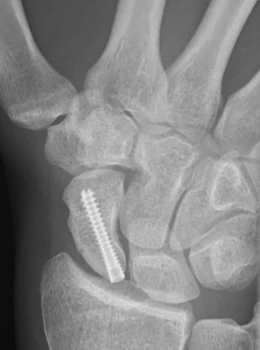
What does the evidence say? In the large SWIFFT trial (31 hospitals) of undisplaced or minimally displaced waist fractures (up to 2 mm), there was no important difference in wrist function between early screw fixation and a cast, and non-union was uncommon with both. So in many cases it is reasonable to start with a cast and keep surgery for fractures that do not heal, while early fixation can be discussed for people who need a faster return to work or sport. [1]
Treatment of scaphoid non-union
If the fracture has not healed despite treatment, or it is found late, the plan changes.
Non-union means the fracture line stays open over time. It is confirmed by a CT scan, which shows the gap and any deformity of the bone, and by an MRI, which shows the blood supply of the near fragment.
Non-union shows as a fracture line that is still open after months, sometimes with deformity of the bone. After a bone graft and fixation, healing is followed on X-rays.
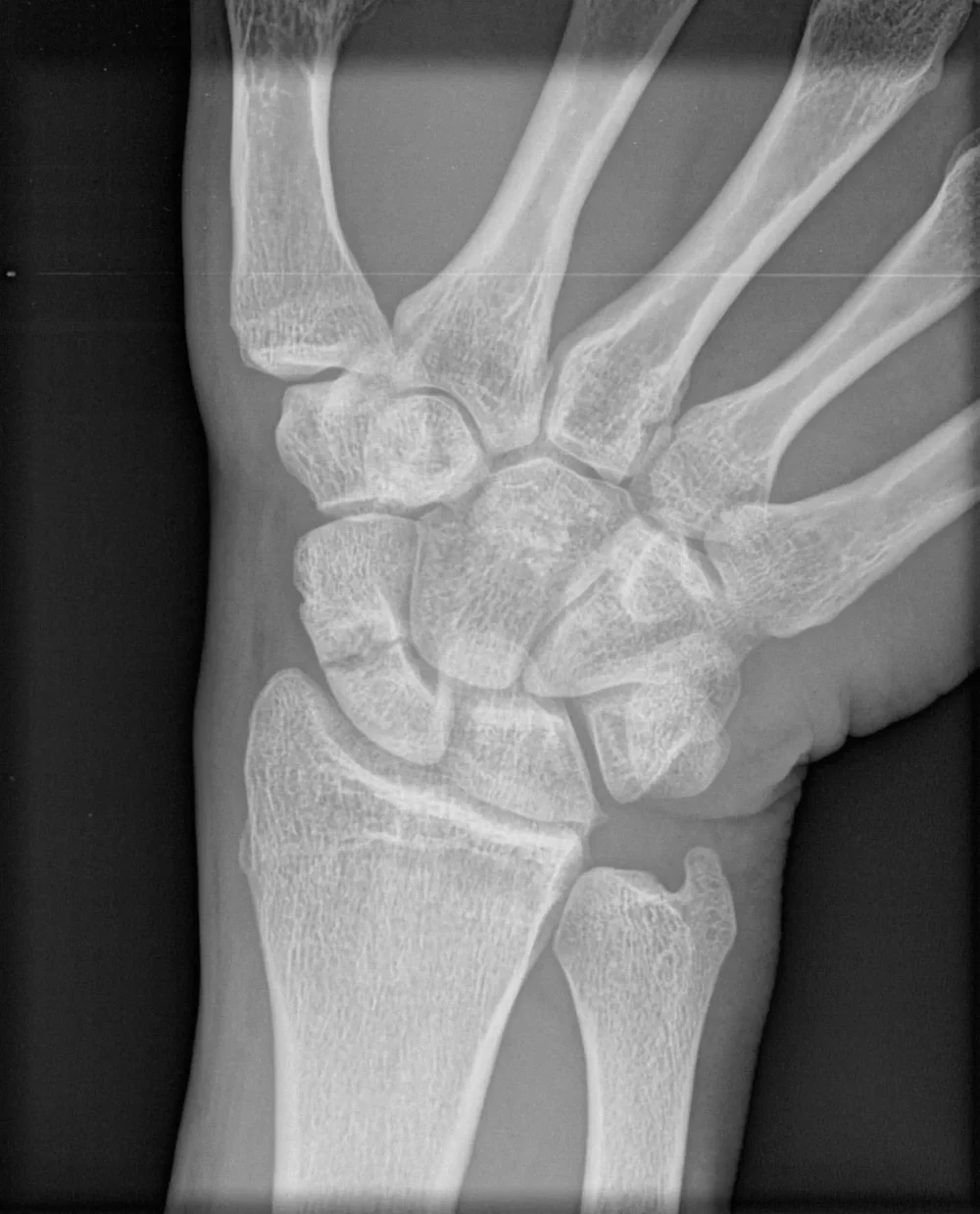
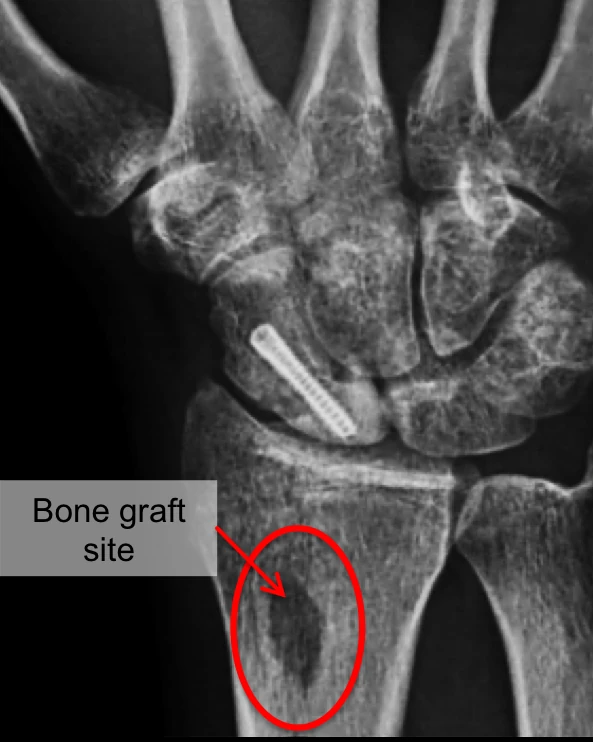
Bone graft with screw fixation
A piece of bone is placed at the fracture and held with a screw. This is the most common choice when the blood supply is good, and a wedge-shaped graft may be used to correct deformity.
Vascularized bone graft
A graft that carries its own blood vessel, from the forearm bone or another bone. It is discussed when the near fragment has lost its blood supply (necrosis), or after a failed earlier operation.
Salvage operations for arthritis (SNAC)
If advanced arthritis has developed, options such as removing the first row of wrist bones, removing the scaphoid with a four-bone fusion, or a wrist fusion are discussed, to relieve pain while keeping acceptable function.
What does the evidence say? Systematic reviews generally do not show a clear advantage of a vascularized graft over an ordinary graft for healing, and an ordinary graft may suit better when there is deformity. When the near fragment has died, one umbrella review suggests higher healing with a vascularized graft (about 74–88% versus 47–62%), but most of the studies are not randomized. [2][3][4]
What to expect during and after treatment
These are approximate and vary from patient to patient and fracture to fracture.
- Cast or splintFor weeks, depending on the fracture type, with follow-up X-rays. A CT scan may be requested to confirm healing.
- After screw fixationA short operation, usually without an overnight stay. Fingers are moved early, and the wrist is used for light activity after a few weeks.
- RehabilitationPhysiotherapy to regain movement and strength once the cast is removed.
- Return to sport and heavy workAfter healing is confirmed on imaging, which can take several months.
Frequently asked questions
Can there be a fracture when the X-ray is normal?
Yes, a scaphoid fracture may not show on the first X-ray. If pain continues, the X-ray is repeated after one to two weeks, or an MRI or CT scan is requested.
Do I always need surgery?
No. Many undisplaced fractures heal in a cast. Surgery is discussed for displaced or unstable fractures, proximal pole fractures, and non-union.
How long does healing take?
Usually weeks to months, slower than most fractures because of the weak blood supply.
I have had wrist pain since a fall years ago. What should I do?
An examination and a CT scan are advised. The fracture may never have healed. Many cases can be treated even after a long time, but arthritis may change the options.
When can I return to sport and work?
It depends on the fracture type and the treatment, and on confirmed healing. Your surgeon will set the right time for your case.
Dr Abdullah AlQaseer
Consultant orthopedic, hand and microsurgeon, with a hand surgery fellowship from Leeds (UK) and the Kuwait Board in Orthopedic Surgery, and seventeen years of experience. I see patients at As-Salam Hospital – Capital.
Do not wait for the pain to get worse
You can book an examination by calling the As-Salam Hospital – Capital call center.
This content is for general information and does not replace a medical examination. Results vary from patient to patient and nothing is guaranteed.
Scientific references
- Dias JJ, et al. Surgery versus cast immobilisation for adults with a bicortical fracture of the scaphoid waist (SWIFFT): a pragmatic, multicentre, open-label, randomised superiority trial. Lancet. 2020;396(10248):390-401.
- Vascularised versus non-vascularised bone graft for scaphoid nonunion: meta-analysis of randomised controlled trials and comparative studies. 2023.
- Graft choice for managing scaphoid non-union: umbrella review. 2024.
- Systematic review of bone grafting for scaphoid nonunion (78 studies). Bone Joint J. 2022;104-B(5).