
A cut tendon in the hand, more than skin stitches
A cut on a finger, palm or the back of the hand from a knife, glass or machine? The tendon may be divided even if the wound looks small. Learn the signs of a tendon injury, how it is repaired, and what the result depends on.
- Consultant orthopedic and hand surgeon
- Hand surgery fellowship – Leeds, UK
- Kuwait Board in Orthopedic Surgery
 Book your appointment atAs-Salam Hospital – Capital

When should I suspect a cut tendon?
These signs call for an examination by a hand surgeon after any cut to the hand, even a small one.
- A cut on the palm side of a finger, the palm or the back of the hand from a knife, glass or machine
- You cannot bend the finger or one of its joints, or straighten it fully
- The finger rests in a different position from its neighbours
- Pain when you try to move it, or a weak grip
- Numbness in the finger, which can mean a nerve was cut as well
- A wound stitched in the emergency room, but movement did not return as before
The size of the wound does not tell you the size of the injury. A small wound can hide a cut tendon or nerve. Ask a hand surgeon to examine you early, and do not stop at stitching the skin.
How do the tendons of the hand work?
Tendons are strong cords that link the forearm muscles to the finger bones. The flexor tendons on the palm side close the hand, and the extensor tendons on the back open it.
A flexor tendon runs inside a narrow tunnel with pulleys that keep it close to the bone, so an injury in the finger is delicate and needs a careful repair that preserves those pulleys.
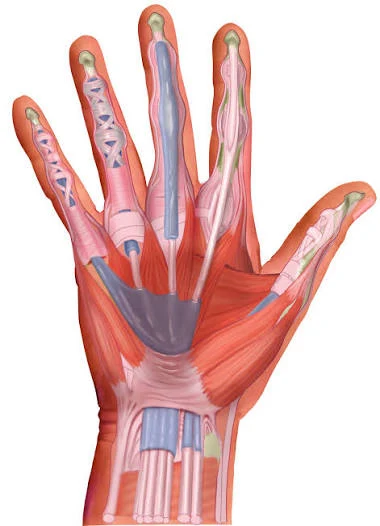
Flexor tendon cuts (palm side of the finger and the palm)
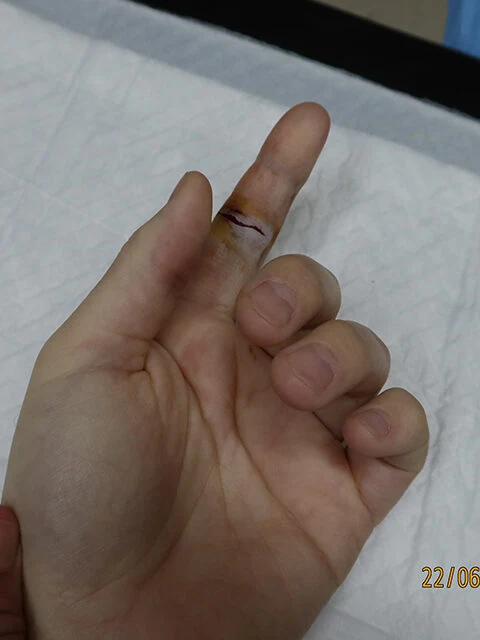
A cut flexor tendon does not heal in a splint alone, because its two ends pull apart. Treatment is therefore usually surgical: the tendon is sewn with strong stitches that run inside its body, plus a surface stitch, and the pulleys it passes under are protected so the finger can glide smoothly.
The strength of the repair matters because movement starts a few days after the operation. Reviews note that a multi-strand repair allows early motion and lowers the risk of rupture, but it adds bulk at the repair and can raise the chance of adhesions, so the surgeon balances strength against gliding [1].
Hand therapy then starts early, with protected movement under a hand therapist and a protective splint. A systematic review found that early active motion programmes, and the Kleinert and Duran programmes, give low rupture rates and acceptable movement in zone II [2]. A 2021 Cochrane review (16 trials, 1108 participants) found the evidence weak and unable to say which programme is best [3], so the surgeon and therapist choose according to the injury and the patient's ability to follow the plan.
Extensor tendon cuts (back of the finger and hand)
Extensor tendons are thin and lie close to the skin and bone, so a cut often comes with a joint wound or a fracture. The tendon is usually sewn, then a splint or a protected-movement programme is used depending on the level of the cut.
Mallet finger is a common fingertip injury: the tendon tears, or a small piece of bone breaks off at the last joint, and the tip no longer straightens. It is usually treated with a continuous splint that keeps the joint straight for about six to eight weeks without removal, followed by night-time splinting. A Cochrane review found the evidence insufficient to choose between splint types, and that the patient's adherence to wearing the splint is central [4].
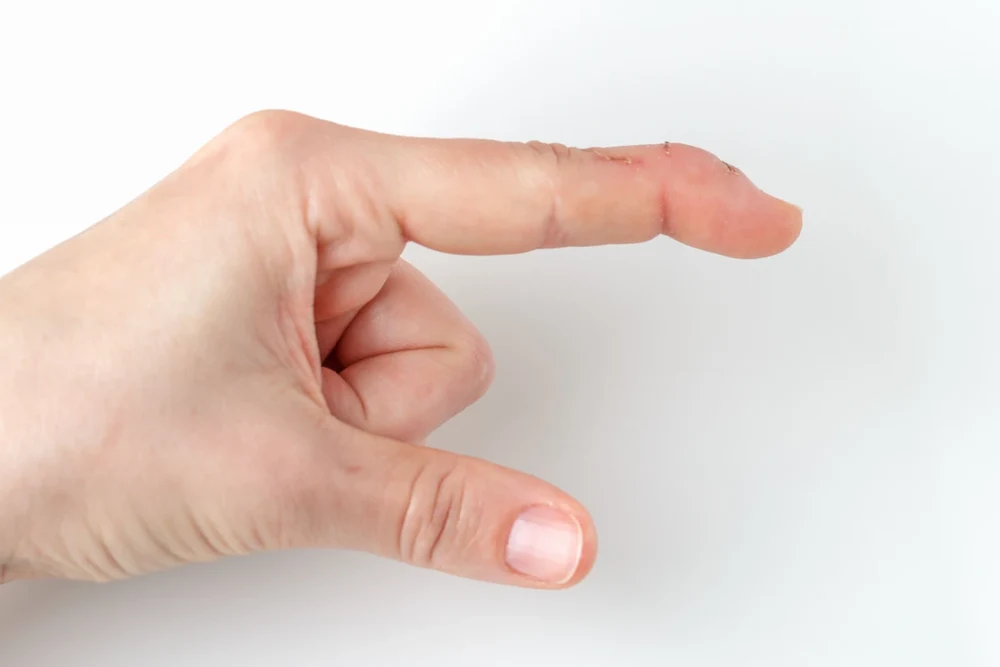
Treatment by type of injury
Durations are approximate and vary from case to case.
| Usual treatment | Approximate duration | Notes | |
|---|---|---|---|
| Complete flexor tendon cut | Surgical repair, then protected movement | Protective splint for several weeks, then hand therapy | Best done early, by a hand surgeon |
| Partial flexor tendon cut | Observation or repair, depending on how much is cut | Decided at examination and surgery | A large partial cut can rupture later and then needs repair |
| Extensor tendon cut on the finger or hand | Tendon repair with a splint or protected movement | Several weeks | Sometimes comes with a joint wound or fracture |
| Mallet finger | Continuous splint for the last joint | Six to eight weeks | Surgery for a limited number of cases |
| Old or late injury | Assessment; may need a tendon graft or a two-stage repair | Varies | Results are less predictable than an early repair |
What does the evidence say? The available evidence supports early protected movement after flexor tendon repair, but it is weak on which single programme is best [2][3]. The result therefore depends a great deal on the quality of the repair and on the patient following the splint and exercise plan.
Why a careful repair from the start?
The first chance at repair is the best one. If the repair is not done well, these problems can follow:
Rupture of the repair
The tendon can tear again if the repair is weak or the finger is moved in a way other than prescribed.
Adhesions and stiffness
The tendon can stick to the tissue around it and stop gliding, leaving a stiff finger that does not close fully.
A second operation
Releasing adhesions or a tendon graft may be needed, and these operations are harder with less predictable results.
What to expect during and after treatment
Stages are approximate and vary from case to case.
- First daysProtective splint, keeping the hand raised, and the first exercises under a hand therapist.
- First weeksProtected movement as per the programme, avoiding any pull on the tendon.
- After thatThe splint is weaned off, followed by exercises to regain movement and strength.
- Heavy manual workAfter the repair is confirmed to be strong, which can take months.
Frequently asked questions
My cut was stitched in the emergency room. Do I still need a hand surgeon?
Yes, if the finger does not bend or straighten fully, or there is numbness. A tendon or nerve cut may not have been noticed.
Can I wait a few days before seeing a hand surgeon?
It is better to be examined early. The surgeon decides the timing of repair according to the wound: some are repaired within days, and some need cleaning first.
Is surgery always needed?
For a complete flexor tendon cut it usually is. Mallet finger is often treated with a splint. A partial cut is decided after examination.
Will full movement return?
That depends on the level of injury, the depth of the wound, how soon it is treated and how well the exercises are followed. Nothing is guaranteed, but a careful repair and good rehabilitation improve the chance.
What if weeks or months have passed since the injury?
The finger and the tendon are assessed. A tendon graft or a two-stage repair may be discussed, but results are less predictable than an early repair.
Dr Abdullah AlQaseer
Consultant orthopedic, hand and microsurgeon, with a hand surgery fellowship from Leeds (UK) and the Kuwait Board in Orthopedic Surgery, and seventeen years of experience. I see patients at As-Salam Hospital – Capital.
Do not delay checking a hand wound
You can book an examination by calling the As-Salam Hospital – Capital call center.
This content is for general information and does not replace a medical examination. Results vary from patient to patient and nothing is guaranteed.
Scientific references
- Zone II flexor tendon repair: number of strands, technique and postoperative rehabilitation – a narrative review. Orthopedic Reviews.
- Chesney A, et al. Systematic review of flexor tendon rehabilitation protocols in zone II of the hand. Plast Reconstr Surg. 2011.
- Peters SE, et al. Rehabilitation following surgery for flexor tendon injuries of the hand. Cochrane Database Syst Rev. 2021 (CD012479).
- Interventions for treating mallet finger injuries. Cochrane Database Syst Rev (CD004574).